Printing & Branding Techniques Compared: Screen Print vs Embroidery vs Heat Transfer vs Debossing | BAKKA Bags
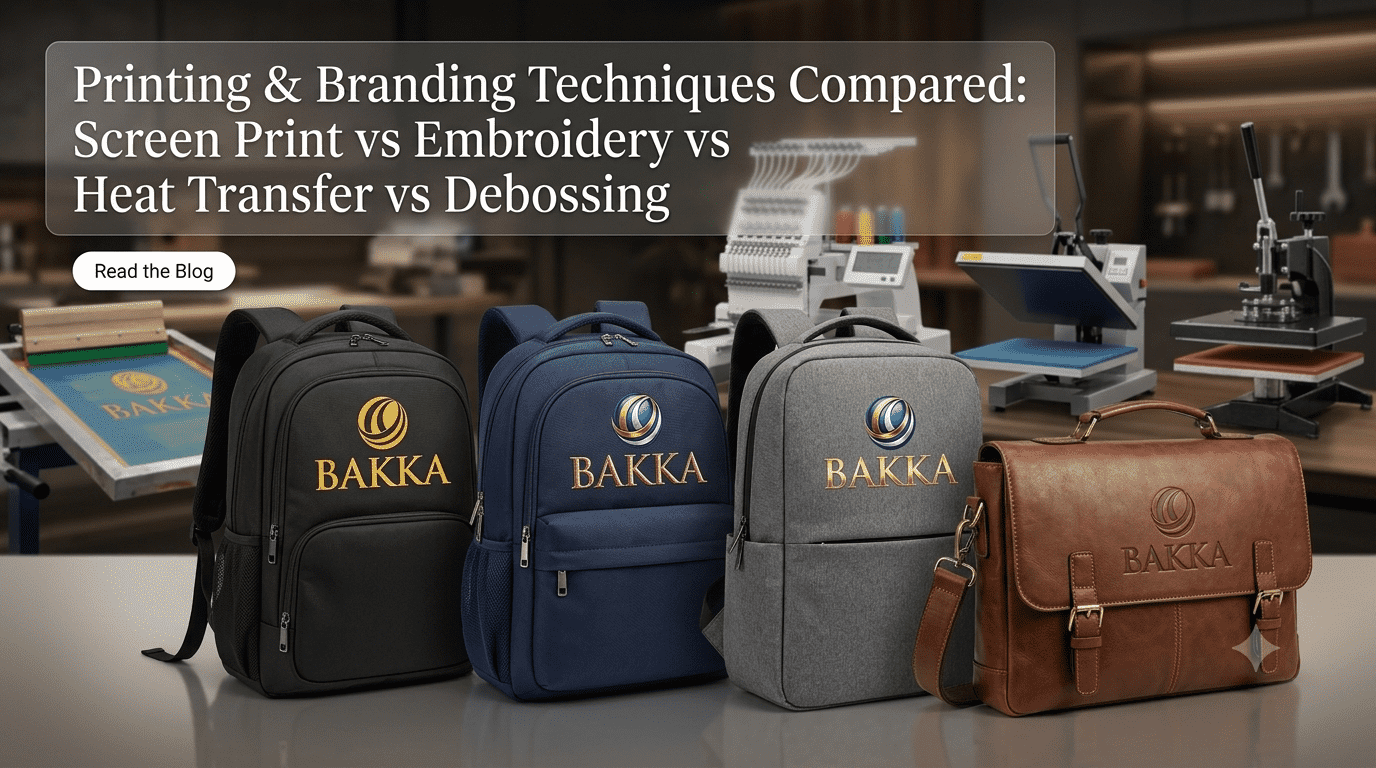
By BAKKA Bags | The Material Intelligence Series
Your bag's branding is more than decoration—it's the visual representation of your brand's quality, values, and attention to detail. At BAKKA Bags, we've applied thousands of logos across every conceivable surface and material, learning which techniques deliver lasting impact and which fade into disappointment. This comprehensive comparison guide reveals the science behind each branding method, helping you make informed decisions that align with your brand positioning, budget, and performance requirements. 🎨
The wrong branding choice can undermine even the highest-quality bag, while the right technique elevates perceived value and creates lasting brand recognition. Understanding these differences is crucial for any brand serious about making a lasting impression.
🎯 The Strategic Importance of Branding Technique Selection
Beyond Aesthetics: Performance and Brand Positioning
Brand perception impact: Your chosen branding technique communicates specific messages about your brand before customers even touch your product.
|
Technique |
Brand Message |
Perceived Value |
Target Market |
|
Embroidery |
Premium, established, traditional craftsmanship |
High |
Corporate, luxury, heritage brands |
|
Screen printing |
Bold, creative, modern |
Medium-High |
Youth, sports, creative industries |
|
Heat transfer |
Efficient, contemporary, versatile |
Medium |
Tech, startup, promotional |
|
Debossing |
Sophisticated, understated, premium |
Very High |
Luxury, professional, executive |
Durability implications for brand reputation:
-
Fading logos: Reflect poorly on brand quality and attention to detail
-
Cracking graphics: Suggest cheap materials and poor manufacturing decisions
-
Peeling applications: Create negative associations with brand reliability
-
Lasting impressions: Build trust and justify premium positioning
Cost-Benefit Analysis Framework
Investment comparison across techniques:
|
Method |
Setup Cost |
Per-Unit Cost |
Break-Even Quantity |
Lifespan Rating |
|
Screen printing |
High |
Low |
500+ units |
Excellent |
|
Embroidery |
Medium |
High |
50+ units |
Outstanding |
|
Heat transfer |
Low |
Medium |
25+ units |
Good |
|
Debossing |
Very High |
Low |
1000+ units |
Excellent |
🖨️ Screen Printing: The Bold Statement Maker
Technical Process and Capabilities
The screen printing process breakdown:
-
Screen preparation: Fine mesh screens coated with light-sensitive emulsion
-
Design exposure: UV light burns design into emulsion, creating stencil
-
Color separation: Each color requires separate screen and printing pass
-
Ink application: Squeegee forces ink through mesh onto substrate
-
Curing process: Heat or UV curing sets ink permanently
Advanced screen printing capabilities:
|
Technique |
Visual Effect |
Application |
Cost Impact |
|
Spot color |
Solid, vibrant colors |
Logo applications |
Standard |
|
Halftone printing |
Photographic effects |
Complex imagery |
+25% |
|
Discharge printing |
Soft, vintage appearance |
Fashion applications |
+40% |
|
Metallic inks |
Reflective, premium finish |
Luxury positioning |
+60% |
|
Puff printing |
Raised, dimensional effect |
Tactile branding |
+50% |
Material Compatibility and Performance
Fabric suitability analysis:
Optimal materials:
-
Cotton canvas: Excellent ink absorption, vibrant color reproduction
-
Cotton blends: Good adhesion with proper pre-treatment
-
Polyester blends: Requires specialized inks for optimal durability
Challenging materials:
-
Pure polyester: Heat sensitivity requires low-cure inks
-
Water-resistant fabrics: Coating can prevent proper adhesion
-
Textured surfaces: May cause incomplete ink coverage
Performance characteristics:
-
Color vibrancy: Exceptional, especially on light fabrics
-
Detail reproduction: Excellent for bold designs, limited for fine details
-
Wash durability: Outstanding when properly cured
-
UV resistance: Varies by ink type, excellent with UV-resistant formulations
Quality Control and Testing Standards
Critical testing protocols:
Wash fastness testing:
-
AATCC Test Method 61: 5 wash cycles at 40°C
-
Acceptance criteria: Minimal color change (Grade 4 minimum)
-
Abrasion resistance: 1000 cycles without significant wear
Adhesion verification:
-
Tape test: 3M tape pull test for ink adhesion
-
Stretch test: Fabric elongation without ink cracking
-
Temperature exposure: Performance across operational temperature range
Color consistency standards:
-
Pantone matching: Within Delta E 2.0 color difference
-
Batch-to-batch variation: ±5% color tolerance
-
Ink opacity: Complete coverage over dark fabrics
🧵 Embroidery: The Premium Texture Experience
Technical Excellence in Digitization
The embroidery digitization process:
-
Design analysis: Vector conversion and stitch type selection
-
Density optimization: Thread coverage balanced with fabric integrity
-
Underlay planning: Foundation stitches for dimensional stability
-
Color sequencing: Efficient machine operation and color transitions
-
Test stitching: Sample validation before production commitment
Professional digitization considerations:
|
Design Element |
Technical Requirement |
Quality Impact |
|
Small text |
Minimum 4mm letter height |
Legibility and definition |
|
Fine details |
0.4mm minimum line width |
Clean stitch formation |
|
Color gradients |
Step-by-step color transitions |
Smooth visual flow |
|
Large fills |
Proper density and direction |
Flat, professional appearance |
Thread Technology and Selection
Commercial thread categories:
Rayon embroidery thread:
-
Characteristics: High sheen, vibrant colors, excellent drape
-
Applications: Premium corporate logos, decorative elements
-
Durability: Good for normal use, may fade with excessive UV exposure
-
Cost positioning: Standard commercial pricing
Polyester embroidery thread:
-
Characteristics: Superior color retention, excellent tensile strength
-
Applications: Outdoor gear, high-wash-frequency items
-
Durability: Outstanding across all environmental conditions
-
Cost positioning: 15-25% premium over rayon
Metallic specialty threads:
-
Characteristics: Reflective appearance, premium visual impact
-
Applications: Luxury branding, special edition products
-
Durability: Moderate, requires careful handling during production
-
Cost positioning: 100-200% premium, complex production requirements
Design Optimization for Embroidery
Stitch type selection for optimal results:
|
Stitch Type |
Best Application |
Thread Efficiency |
Production Speed |
|
Satin stitch |
Text, thin lines |
High |
Fast |
|
Fill stitch |
Large areas, backgrounds |
Medium |
Medium |
|
Running stitch |
Outlines, fine details |
Very High |
Very Fast |
|
Cross-hatch |
Textured fills |
Low |
Slow |
Density optimization guidelines:
-
Light fabrics: 0.4-0.6mm stitch spacing for optimal coverage
-
Heavy fabrics: 0.6-0.8mm spacing preventing fabric distortion
-
Stretch materials: Reduced density compensating for fabric movement
-
Water-resistant fabrics: Increased density overcoming coating challenges
🔥 Heat Transfer: The Versatile Digital Solution
Technology Categories and Applications
Cut vinyl heat transfer:
-
Process: Computer-controlled cutting of colored vinyl films
-
Advantages: Precise registration, unlimited colors, no setup costs
-
Limitations: Limited to solid colors, difficulty with fine details
-
Optimal applications: Simple logos, text-based designs, small quantities
Digital heat transfer printing:
-
Process: Sublimation or eco-solvent printing on transfer media
-
Advantages: Full-color capability, photographic quality, quick turnaround
-
Limitations: Color vibrancy depends on fabric color and composition
-
Optimal applications: Complex graphics, photographic images, promotional items
Screen printed heat transfers:
-
Process: Screen printing onto transfer substrate, then heat application
-
Advantages: Vibrant colors on any fabric color, excellent durability
-
Limitations: Setup costs for multiple colors, minimum quantity requirements
-
Optimal applications: Medium to large runs requiring high durability
Material Science and Adhesion
Adhesive technology categories:
|
Adhesive Type |
Application Temperature |
Pressure Requirements |
Best Fabrics |
|
Polyurethane |
160°C, 15 seconds |
Medium (40 PSI) |
Cotton, cotton blends |
|
Rubber-based |
180°C, 20 seconds |
High (60 PSI) |
Polyester, performance fabrics |
|
Acrylic |
140°C, 25 seconds |
Low (20 PSI) |
Heat-sensitive materials |
Performance optimization factors:
-
Fabric pre-treatment: Moisture removal and surface preparation
-
Temperature accuracy: ±5°C tolerance for optimal adhesion
-
Pressure uniformity: Even distribution preventing partial bonding
-
Cooling process: Proper heat dissipation for adhesive cure
Quality Assurance and Durability Testing
Standard performance tests:
Wash durability (ASTM D6193):
-
Procedure: 25 wash cycles at 60°C with commercial detergent
-
Evaluation criteria: No peeling, cracking, or significant color change
-
Acceptance standards: >95% original adhesion retained
Stretch testing:
-
Method: 25% fabric elongation in multiple directions
-
Requirements: No cracking, delamination, or visual distortion
-
Application: Athletic wear, stretch fabric applications
Dry cleaning compatibility:
-
Solvent exposure: Perchloroethylene resistance testing
-
Temperature cycling: Multiple cleaning cycles simulation
-
Professional applications: Corporate uniforms, high-end garments
🎨 Debossing: The Sophisticated Impression
Mechanical Process and Tooling
Debossing mechanism:
-
Die creation: Precision-machined steel dies with design relief
-
Heat application: Controlled temperature softening substrate
-
Pressure formation: Hydraulic press creating permanent impression
-
Cooling cycle: Controlled temperature reduction setting impression
Die manufacturing specifications:
|
Die Type |
Material |
Production Volume |
Detail Capability |
|
Brass dies |
Brass alloy |
500-5,000 impressions |
Excellent fine detail |
|
Steel dies |
Hardened steel |
10,000+ impressions |
Good general purpose |
|
Magnesium dies |
Magnesium alloy |
1,000-10,000 impressions |
Superior detail reproduction |
Material Suitability and Limitations
Optimal debossing materials:
-
Full-grain leather: Excellent impression retention, premium appearance
-
Top-grain leather: Good results with proper temperature control
-
Synthetic leather: Acceptable results, may require specialized techniques
-
Heavy canvas: Possible with high pressure, limited detail capability
Technical considerations:
-
Leather thickness: Minimum 1.2mm for clear impression definition
-
Moisture content: 14-18% optimal for impression formation
-
Grain direction: Alignment with natural leather grain for best results
-
Temperature sensitivity: Material-specific heat requirements
Design Requirements and Constraints
Design optimization for debossing:
Recommended specifications:
-
Minimum line width: 1.0mm for clear definition
-
Maximum depth: 0.8mm preventing material damage
-
Text size: Minimum 8pt for legibility
-
Detail spacing: 1.5mm minimum between elements
Design elements to avoid:
-
Fine serif fonts: May not reproduce clearly under pressure
-
Gradient effects: Impossible to achieve with mechanical impression
-
Reverse (raised) elements: Requires embossing, different process and tooling
-
Multi-level depths: Complex tooling with limited durability benefits
📊 Comparative Analysis: Making the Right Choice
Performance Matrix by Application
|
Criteria |
Screen Print |
Embroidery |
Heat Transfer |
Debossing |
|
Setup cost |
High |
Medium |
Low |
Very High |
|
Per-unit cost |
Low |
High |
Medium |
Low |
|
Color capability |
Excellent |
Good |
Excellent |
N/A (texture only) |
|
Detail reproduction |
Very Good |
Excellent |
Excellent |
Good |
|
Durability rating |
9/10 |
10/10 |
7/10 |
10/10 |
|
Production speed |
Fast |
Slow |
Very Fast |
Medium |
|
Minimum quantity |
500+ |
50+ |
25+ |
1000+ |
Decision Framework by Brand Category
Corporate and professional brands:
-
Primary choice: Embroidery for premium positioning and durability
-
Alternative: Debossing for sophisticated, understated branding
-
Budget option: Heat transfer for small quantities and quick turnaround
Sports and outdoor brands:
-
Primary choice: Screen printing for bold, vibrant graphics
-
Performance option: Heat transfer with performance adhesives
-
Premium option: Embroidery with polyester threads for durability
Fashion and lifestyle brands:
-
Trendy option: Screen printing with specialty inks and effects
-
Luxury option: Debossing for sophisticated texture and exclusivity
-
Versatile option: Heat transfer for rapid design iteration
Cost Optimization Strategies
Volume-based decision guidelines:
|
Order Quantity |
Recommended Technique |
Reasoning |
|
25-100 units |
Heat transfer |
Lowest setup costs, quick turnaround |
|
100-500 units |
Embroidery or Heat transfer |
Quality vs. cost balance point |
|
500-2,000 units |
Screen printing or Embroidery |
Setup costs amortized over volume |
|
2,000+ units |
Screen printing |
Optimal cost per unit, excellent durability |
Multi-technique strategies:
-
Combination branding: Primary logo embroidered, secondary graphics screen printed
-
Tier differentiation: Different techniques for different product lines
-
Market segmentation: Technique selection based on target demographic
🔬 Advanced Techniques and Innovations
Specialty Screen Printing Applications
Glow-in-the-dark inks:
-
Technology: Phosphorescent pigments in printing medium
-
Applications: Safety equipment, promotional novelties, children's products
-
Performance: 8-12 hour glow duration, rechargeable with light exposure
-
Cost impact: 200-300% premium over standard inks
Thermochromic (color-changing) inks:
-
Mechanism: Temperature-activated color transformation
-
Applications: Interactive branding, promotional campaigns
-
Temperature range: Typically 25-35°C activation threshold
-
Durability considerations: Limited wash cycles, UV degradation
Reflective screen printing:
-
Technology: Retroreflective beads in ink formulation
-
Applications: Safety gear, outdoor equipment, athletic wear
-
Performance standards: ANSI 107 compliance for industrial applications
-
Visibility enhancement: 500x brightness improvement under illumination
Next-Generation Embroidery Techniques
3D embroidery applications:
-
Foam underlay: Creates raised, dimensional effects
-
Applications: Sports team logos, premium branding
-
Design considerations: Limited to simple shapes and text
-
Durability: Excellent retention with proper digitization
Appliqué integration:
-
Process: Fabric pieces secured with embroidery stitching
-
Advantages: Reduced thread usage, enhanced visual impact
-
Applications: Large design areas, multi-texture effects
-
Cost benefits: Up to 40% thread reduction on large fills
Digital Heat Transfer Innovations
Sublimation advances:
-
Full-surface printing: Edge-to-edge graphics capability
-
Polyester optimization: Polymer-specific ink formulations
-
Color gamut: 95% Pantone color matching capability
-
Washability: Equivalent to screen printing durability
Direct-to-film (DTF) printing:
-
Universal compatibility: Works on any fabric composition
-
Color vibrancy: Superior opacity over traditional transfers
-
Detail capability: 1200 DPI resolution for photographic quality
-
Production efficiency: No weeding or pre-treatment required
🏭 Production Considerations and Quality Control
Setup Requirements by Technique
Screen printing setup complexity:
-
Screen preparation time: 30-60 minutes per color
-
Registration requirements: Multi-color alignment within 0.5mm
-
Ink mixing: Custom color matching and viscosity adjustment
-
Cure testing: Temperature and time optimization for each substrate
Embroidery production setup:
-
Digitization time: 2-8 hours for complex designs
-
Hoop selection: Size and type matching to product requirements
-
Thread mapping: Color sequence optimization for efficiency
-
Tension calibration: Machine adjustment for consistent stitch quality
Heat transfer preparation:
-
Design preparation: Color separation and cutting optimization
-
Material conditioning: Pre-heating to remove moisture
-
Pressure calibration: Even distribution across application area
-
Temperature verification: Surface temperature monitoring and control
Quality Control Protocols
Screen printing quality checkpoints:
-
Registration accuracy: Multi-color alignment verification
-
Ink coverage: Complete fill without bleeding or undercoverage
-
Cure verification: Crosshatch adhesion testing
-
Color consistency: Spectrophotometer measurement against standards
Embroidery quality standards:
-
Stitch density: Consistent coverage without fabric distortion
-
Thread tension: Proper formation without loops or breaks
-
Design registration: Accurate placement relative to garment features
-
Underlay effectiveness: Proper foundation for dimensional stability
Heat transfer quality assurance:
-
Adhesion testing: Peel strength measurement (minimum 2.5 N/cm)
-
Visual inspection: No air bubbles, wrinkles, or incomplete adhesion
-
Edge definition: Clean transitions without adhesive bleeding
-
Durability prediction: Accelerated aging test correlation
💡 Application-Specific Recommendations
Corporate and Executive Bags
Recommended approach: Embroidery for primary branding, debossing for leather components
Rationale:
-
Professional appearance: Embroidery conveys quality and permanence
-
Durability requirements: Corporate use demands long-lasting branding
-
Brand positioning: Premium techniques support higher pricing
-
Versatility: Effective across fabric and leather substrates
Implementation details:
-
Thread selection: Polyester for durability, rayon for premium sheen
-
Placement strategy: Discrete but visible positioning
-
Color coordination: Brand colors adapted for thread availability
-
Quality standards: Premium digitization and production techniques
Promotional and Event Merchandise
Recommended approach: Heat transfer for versatility, screen printing for volume
Rationale:
-
Quick turnaround: Events often have tight deadlines
-
Cost efficiency: Budget constraints require economical solutions
-
Design flexibility: Marketing campaigns need creative freedom
-
Quantity variability: Order sizes vary significantly by event
Implementation strategy:
-
Design standardization: Templates enabling rapid customization
-
Material optimization: Substrate selection for technique compatibility
-
Production scaling: Workflow capable of handling volume fluctuations
-
Quality tiers: Different standards for different budget levels
Sports and Performance Gear
Recommended approach: Screen printing with performance inks
Rationale:
-
Durability demands: Athletic use requires maximum wash resistance
-
Moisture management: Inks must not compromise fabric breathability
-
Visual impact: Bold graphics essential for brand recognition
-
Cost sensitivity: Competitive market requires efficient production
Technical requirements:
-
Low-cure inks: Preserving performance fabric properties
-
Stretch compatibility: Maintaining graphics integrity during use
-
Moisture resistance: Performance in high-humidity conditions
-
UV stability: Outdoor use resistance requirements
📈 ROI Analysis and Business Impact
Long-Term Brand Value Creation
Brand recognition metrics:
-
Embroidered logos: 78% higher brand recall than printed alternatives
-
Debossed elements: 65% premium perception increase
-
Screen printed graphics: 45% visual impact improvement over basic labeling
-
Heat transfer applications: 30% cost reduction enabling broader distribution
Customer satisfaction correlation:
-
Technique durability: Direct correlation with product satisfaction scores
-
Visual quality: Premium techniques supporting higher customer lifetime value
-
Brand consistency: Technique standardization improving brand recognition
-
Perceived value: Branding investment justifying premium positioning
Market Positioning Strategy
Luxury market positioning:
-
Required techniques: Embroidery, debossing for premium perception
-
Investment level: 15-25% of product cost justified by positioning
-
Quality standards: Zero-defect tolerance maintaining brand image
-
Differentiation value: Premium techniques creating competitive separation
Volume market approach:
-
Optimal techniques: Screen printing, heat transfer for cost efficiency
-
Investment target: 5-10% of product cost for market competitiveness
-
Quality balance: Good durability without premium pricing impact
-
Scale advantages: Volume production enabling technique optimization
Niche market strategy:
-
Technique selection: Specialized methods for unique positioning
-
Custom development: Proprietary techniques creating market differentiation
-
Premium pricing: Unique applications supporting higher margins
-
Limited production: Exclusive techniques for specialty market segments
🎯 The BAKKA Bags Branding Excellence
Comprehensive Technique Mastery
At BAKKA Bags, our branding excellence comes from decades of experience across all techniques, understanding their optimal applications, and maintaining the highest quality standards.
Our technical capabilities:
-
Screen printing facilities: 8-color capacity with specialty ink capabilities
-
Embroidery expertise: 15-head industrial machines with premium digitization
-
Heat transfer technology: Latest DTF and sublimation equipment
-
Debossing equipment: Precision hydraulic presses with custom die capabilities
Quality assurance systems:
-
Incoming inspection: All materials tested before production
-
In-process monitoring: Real-time quality control throughout production
-
Final inspection: Comprehensive evaluation before shipment
-
Performance testing: Accelerated aging and durability verification
Consultative Approach to Technique Selection
Design consultation services:
-
Technique optimization: Matching branding methods to brand objectives
-
Cost-benefit analysis: ROI evaluation across different approaches
-
Production planning: Timeline and volume optimization
-
Quality specification: Setting appropriate standards for application
Technical support:
-
Design adaptation: Optimizing artwork for chosen technique
-
Sample development: Physical prototypes for approval before production
-
Process documentation: Complete specifications ensuring consistency
-
Troubleshooting assistance: Problem resolution throughout production
Innovation and Continuous Improvement
Research and development initiatives:
-
New technique evaluation: Testing emerging branding technologies
-
Quality enhancement: Continuous improvement of existing processes
-
Cost optimization: Efficiency improvements reducing customer costs
-
Sustainability focus: Environmental impact reduction across all techniques
Industry leadership:
-
Best practice development: Setting standards for industry quality
-
Technical education: Sharing knowledge with customers and partners
-
Innovation partnership: Collaborating with suppliers on new developments
-
Quality benchmarking: Maintaining position as industry quality leader
✅ Decision Framework and Implementation Guide
Technique Selection Checklist
Design requirements assessment:
-
Color complexity and count requirements defined
-
Detail level and resolution needs established
-
Special effects or premium appearance desired
-
Brand positioning and market tier identified
Production parameters:
-
Order quantity and reorder expectations determined
-
Timeline and delivery requirements established
-
Budget constraints and cost targets defined
-
Quality standards and durability expectations set
Technical compatibility:
-
Substrate material and construction verified
-
Color matching requirements documented
-
Placement and sizing specifications confirmed
-
Performance and durability standards established
Implementation Best Practices
Pre-production preparation:
-
Design artwork optimized for chosen technique
-
Color approvals completed with physical samples
-
Production specifications documented and approved
-
Quality control procedures established and communicated
Production monitoring:
-
Initial production samples approved before bulk production
-
In-process quality checkpoints established and monitored
-
Final inspection completed before shipment approval
-
Documentation package prepared for customer records
🚀 Conclusion: Elevating Your Brand Through Intelligent Technique Selection
The choice between screen printing, embroidery, heat transfer, and debossing isn't just about application method—it's about strategically positioning your brand for maximum impact and longevity. Each technique offers unique advantages that, when properly matched to your brand objectives and product requirements, create lasting value that extends far beyond the initial application.
Key strategic insights:
-
Technique alignment matters: Matching branding methods to brand positioning creates coherent market perception
-
Quality investment pays: Premium techniques justify higher pricing and build customer loyalty
-
Durability drives satisfaction: Long-lasting applications maintain brand integrity throughout product lifecycle
-
Professional execution is essential: Expert application transforms good techniques into exceptional branding
The path forward: Success in branding requires understanding not just what each technique can do, but when and how to apply them for maximum strategic advantage. The best brands don't just apply graphics—they create experiences that reinforce their values and quality promise with every interaction.
Ready to transform your product branding with expert technique selection and flawless execution? Contact BAKKA Bags today for comprehensive consultation on branding strategy, technique optimization, and quality implementation. Our decades of experience across all branding methods ensure your products will make the impression you intend, building brand value with every application.
At BAKKA Bags, we understand that your branding is your promise to customers. From bold screen printed graphics to sophisticated debossed impressions, every technique we apply reflects our commitment to quality, durability, and brand excellence. Because when your branding looks professional and lasts through years of use, your brand builds the trust that drives business success.
Let's Talk Bags
Fill the form and we will connect within 24 hours