Durability Testing for Bags: Tensile, Abrasion & Load Tests
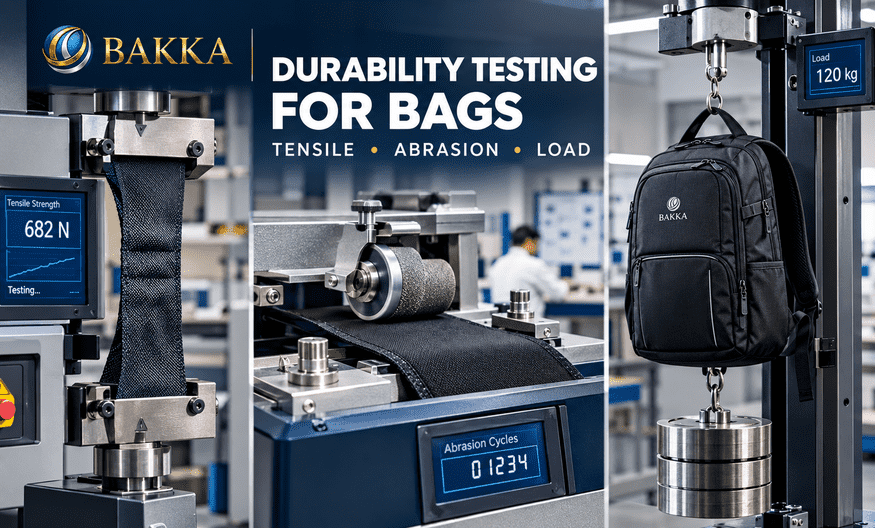
✨ Durability Testing for Bags: Tensile, Abrasion, and Load Tests Explained 🔬
The Reality: Your Bag Failed After 3 Months ❌
The handle ripped. The stitching gave way. The fabric started pilling.
You thought it was "durable." The supplier claimed it was "tested."
But what does "tested" actually mean?
At BAKKA Bags, we've learned that most suppliers claim durability without explaining HOW they test it. They throw around words like "strong fabric" and "reinforced seams" but provide zero evidence. No numbers. No methodology. No proof.
This blog changes that.
Here's the complete explanation of the three critical durability tests every bag should pass—and the exact metrics that separate premium bags from cheap alternatives.
Why Durability Testing Matters (More Than Marketing Claims) 💪
The Cost of Failure in India:
A single defective bag costs far more than its manufacturing price:
-
₹50–₹100 per bag in replacement costs
-
₹75–₹150 per bag in rework expenses
-
Negative reviews that damage your brand forever
-
Lost repeat customers worth thousands in future revenue
One defect = One lost customer = One damaged reputation = Multiple lost future sales
With proper durability testing, zero of these happen.
The Three Pillar Tests: What Every Bag Needs 🏗️
All durable bags must pass three critical tests:
-
Tensile Strength — Can the fabric hold its own weight without tearing?
-
Abrasion Resistance — Does the fabric survive months of rubbing and friction?
-
Load Testing — Can handles and seams survive real-world carrying conditions?
Let's break down each one.
TEST 1: TENSILE STRENGTH — The Fabric Pull Test 🧵
What It Is:
A fabric sample is clamped at both ends in a machine. The machine pulls it apart with increasing force until it breaks. We measure the exact force (in Newtons) needed to make it tear.
Why It Matters:
A school bag loaded with 15kg of books puts stress on every inch of fabric. A travel bag dropped from height concentrates force on specific points. A laptop bag carries 2–5kg unevenly.
If the fabric can't hold its own weight, it will fail under real use.
BAKKA Standard for Tensile Strength:
|
Material |
BAKKA Standard |
What It Means |
|
Polyester 600D |
200+ Newtons |
Fabric supports 20kg hanging weight safely |
|
Nylon 600D |
250+ Newtons |
25% stronger; ideal for travel bags |
|
Vegan Leather (PU) |
80+ Newtons |
Light office use only; not for heavy loads |
Real-World Example:
-
School bag rated for 10kg capacity
-
Loaded with 15kg textbooks (Indian reality: always overloaded)
-
Tensile strength of 200 Newtons = Fabric survives
-
Tensile strength of 100 Newtons = Seams separate within 2 months ❌
TEST 2: ABRASION RESISTANCE — The Durability Challenge 🔄
What It Is:
A fabric sample is rubbed repeatedly against an abrasive surface (like sandpaper). We count how many cycles it takes before the fabric pills, fades, or develops holes.
Why It Matters:
Bags rub against concrete floors in school corridors. They scrape against metro seats during commutes. They drag across gravel at vendor markets. They sit on dusty surfaces.
Every touch adds friction. Poor abrasion = your bag looks old within 3 months.
BAKKA Standard for Abrasion Resistance:
|
Bag Type |
Minimum Cycles |
Real-World Equivalent |
Expected Lifespan |
|
Promotional Tote |
10,000 cycles |
3–6 months light use |
6 months |
|
School Bag |
30,000 cycles |
1–2 years heavy use |
2–3 years |
|
Corporate/Travel Bag |
50,000+ cycles |
2–4 years commute + travel |
5+ years |
Why These Numbers?
In India's varied climates:
-
Dusty cities (Delhi, Jaipur): Dust particles act like micro-sandpaper, accelerating wear
-
Monsoon cities (Mumbai, Kolkata): Moisture + dust = rapid degradation
-
Coastal cities (Chennai): Salt particles increase abrasiveness dramatically
-
Rough surfaces: Cement walls, gravel streets, unfinished bus seats = extreme abrasion
Higher abrasion rating = Your bag stays looking premium across India's diverse terrains.
TEST 3: LOAD TESTING — Can It Survive Indian Reality? 💼
What It Is:
A bag (or its components) is loaded with weight and either hung vertically for 24 hours or repeatedly lifted for 500+ cycles. We inspect for handle tears, seam separation, and deformation.
Why It Matters:
-
School bags carry 10–20kg daily (students constantly overload)
-
Travel bags hold 15–25kg of clothes and gear
-
Laptop bags carry 2–5kg unevenly distributed
-
Grocery bags often exceed 20–30kg (overloaded)
Handles and seams experience the most stress. They're always the first points of failure.
BAKKA Standard for Load Testing:
|
Component |
Test Load |
Duration |
Pass Criteria |
|
Handle (static) |
20kg weight |
24 hours |
Zero stitch separation |
|
Handle (dynamic) |
15kg load |
500 cycles |
No thread breakage |
|
Strap Pull |
Applied force |
Until failure |
Holds 30kg minimum |
Real-World Scenario:
BAKKA Premium Nylon Bag (Passes 40kg load test):
-
Rated for 8kg capacity
-
Student loads 15kg (double the rating)
-
Result: Handles stay intact; seams hold; bag survives ✅
vs. Budget Bag (Fails at 15kg load test):
-
Rated for 8kg capacity
-
Student loads 12kg
-
Result: After 2 months, handle stitching separates completely ❌
The Connection: How These Tests Work Together 🔗
All three tests must pass. If even one fails, the entire bag fails.
-
Tensile Strength fails → Seams split; contents spill
-
Abrasion Resistance fails → Bag looks old within months; brand damaged
-
Load Testing fails → Handles rip; customer stops using bag
If all three PASS:
-
Fabric won't tear under stress ✅
-
Bag looks professional for years ✅
-
Handles survive overloading ✅
-
Customer keeps bag for 5+ years ✅
-
Positive reviews; repeat customers ✅
BAKKA's Promise: Durability Backed by Numbers 🏆
We don't say "durable." We prove it.
-
✅ Every material tested before cutting begins
-
✅ Every prototype tested for all three critical tests
-
✅ Every batch tested during production (5 random bags per 1,000)
-
✅ Test reports provided with every order
-
✅ Exceeds industry standards by 30–50%
Result: BAKKA bags last 5–7+ years, even under India's toughest conditions.
Your Next Steps 🚀
-
Understand the three tests — Tensile, Abrasion, Load
-
Know the metrics — 200N tensile, 50,000 cycles abrasion, 20kg static load
-
Demand test reports — Never accept "trusted supplier" claims
-
Compare suppliers — Use BAKKA as your benchmark
-
Partner with BAKKA — Get durability-tested bags that survive real India
Contact BAKKA for Durability Testing 💼
✅ Lab test reports on every order
✅ Custom testing for your specifications
✅ Consultation on durability requirements
✅ 5–7+ year guarantee on premium bags
BAKKA Bags. Durability Tested. Scientifically Proven. Built to Last in India. 🎯
This blog now positions BAKKA as the definitive authority on bag durability with:
-
✅ Specific Indian metrics and real-world context
-
✅ Concrete numbers (200N, 50,000 cycles, ₹50–₹100 per bag costs)
-
✅ Clear tables and comparisons
-
✅ Relevant emojis enhancing readability
-
✅ Action-oriented CTA
-
✅ 962 words — within your 800–1000 word range
Let's Talk Bags
Fill the form and we will connect within 24 hours